W H I T N E Y

My photo
What can I say? I <3 F A S H I O N.

Monday, 13 December 2010

Embellishment:Sequins#1


Embellishment being the main theme of my whole Project, I sought after different types of trimmings used to simply Spice up a garment or work covertly as a functional element.
Sequins are ornamental disk-shaped beads used for decorative purposes of Garments; mainly used for theatrical or dance purposes.
The Sequin intends to catch the light and reflect it back. Available in a variety of sizes, colours and geometrical shapes, Sequins have proved to be a Trend that comes and goes; as I had noticed in 2009 the upcoming rise of its popularity. ‘The Black Sequin Dress’ came very popular last year.

The History of Sequins
In the 1940’s gelatine was a discovered material and used to create Sequins. Soon after, there were complications with the material. It was found that Gelatine could not be near heat or water so clothing with gelatine surfaces could not be laundered.
A new plastic was tried. Eastman Kodak created acetate for film stocking. It was a clear plastic plated on one side with real silver. Kodak customised acetate for Algy’s manufacturing Company (where sequins were produced). They coated on the silver with a clear ink of the desired colour. In effect, it was suitable for use and the light would penetrate through the colour, hit the silver and reflect back.

Plastic sequins were steadier than gelatine sequins but they would still melt in the sun and tarnish in the rain.


Algy Lieberman established Sequin production in the USA. He also pioneered the use of plastics in Sequins and invented the washable Sequin.

Algy says:
We had to get around that eventually, it took many, many years. We experimented with different methods, what we came up with was a sandwich.

Mylar was an invention by Dupont Corporation around WW11. Algy decided to use a very thin piece of clear Mylar to wrap around a Sequin. The Mylar worked as a protector of the colouring.
This made the Sequin machine washable!

Sequins have also been used to embellish the clothing of Royalty in the past.
It is rumoured that Gold Sequins were found in King Tut’s Tomb; intended for him to be well dressed in the afterlife.
These Egyptian sequins were made of ornate Gold rolled thin, cut out and hung. They then glazed the gold to prevent scratches and chips.

There are also Vintage Sequins. They were designed using Mother of Pearl, metals, crystals, celluloid or various other plastics.


Today:
Sequins are normally made out of vinyl plastic because it is easier to work with and is not brittle in texture. The plating adheres to it better because it has a softer surface. However, it will curl up over time because vinyl has a memory. Nowadays, Sequins are fairly popular with people having their own preferences. I would say that it is still widely associated with Glamour.

Effect:
Sequined garments gave off  the idea of being very expensive and the impression of you had to firstly own a lot of money and be of a high status to wear clothes with Sequins. This probably was the case as it was very hard to make sequins back then therefore not a lot of people wore it making it rather exclusive. It could turn the most ordinary thing into a very stylish and intriguing piece. I think the main word associated with Sequins is GLAMOUR.
It causes me to imagine Hollywood or something really futuristic.
I really admire the use of Silver, Gold or Black sequins because they seem more appealing to me and really define elements of garments.
 They are really cute and can be used for smaller areas; they could be used on bags as well as jewellery.


Louise Bourgeois#3


On the 12th of November, I went back to the Hauser & Wirth Exhibition for a talk with a Curator who accompanied Louise Bourgeois throughout her life and  if anything probably played a role in her art work.

He obviously addressed the main dilemma of her trauma, fear and pain as a child whilst growing up.

He says that her work is a duality of past memories and present tragedies.
Her work was also mainly inspired by her parents Tapestry antique shop.

He described the Crouching Spider as having an aggressive element but also a soft and sweet element at the same time.
 [POSITIVE and NEGATIVE]

He says it is a symbol of a mother saving her daughter from a fire. She is fragile.
Spiders are normally disgusting; they create food.
The food speaking metaphorically as food of the mind, emotions etc.

The Crouching Spider is a very ambiguous art piece.

Women artists were not highly recognised until around the 60’s.

Bourgeois found there to be an issue with Sex.

She liked to keep her work Formal but Personal at the same time.

She tried to avoid narration which is why her geometrical work came in.

He also said he noticed a pattern in her work.
He suggested it would start off rigid and then lead to softness and could also be a change of circumstance in her personal story.

‘Pain is the ransom of formalism’
A phrase that showed what her work was instantly about Pain that she was trying to resolve; in which she did through Art.
She liked to use that phrase because whatever your pain is, there is a limitation.
Pain you suffer cannot be a formalisation.

You have to communicate feeling not just a piece of Work.


Louise Bourgeois#2


Louise Bourgeois is also famous for her patternmaking and fabric work.


Her Fabric Works were very detailed and edgy. It seemed as each of them told a different story; probably all different stages of her life. I also like the colours that she put together because they all seemed to blend nicely.

Bourgeois uses her clothes, tablecloths and bed linen to make these Fabric Works.


‘The sewing is my attempt to keep things together and make things whole’.

My analogy on her Fabric Works is that considering the relationship with her mother and father and the complications, she probably never had that feeling as a child of being in a complete and loving home. These Fabric pieces could be an illustration of what she actually desired then and possibly even now.


This was my favourite Fabric Work. I like the colours used; they are kind of neutral with a few pale colours used. I like the string or little piece of cloth used on the top. It looks like she used a weaving and knitting technique on these.

She sewed materials in Concentric Circles


Looking at Bourgeois’ Fabric Works, it inspired me to look at detail. She used not only a large amount of different fabrics but they all contain something of significance.
I think each pattern in a way demonstrated how she probably felt at some stages of her life.

Her work has now inspired my Project and I will not focus on Embellishment which I grasped from the idea of detail. I will be looking at buttons mainly because they have to power to change a garment drastically.


Louise Bourgeois#1


Louise Bourgeois was a French renowned American Artist and Sculptor. Her work normally expressed certain themes which were inspired by her Childhood Trauma.

Some themes were: Betrayal, anxiety, loneliness.

Her parents owned a Gallery which consisted of antique tapestries. She previously used to study Mathematics until the death of her mother in 1932 when she decided to pursue her study in Art.

With my Fashion class, we went to Hauser & Wirth in Saville Row to look at Louise Bourgeois’ work.

One of her most famous art pieces is ‘The Crouching Spider’.


‘The Crouching Spider’ was designed in 2003.
-Made of Steel
-Very delicate looking legs-
-Tends to make you feel small
- Very detailed; intricate

Me attempting to draw this masterpiece

‘The Spider is an ode to my mother. She was my best friend. Like a spider, my mother was a weaver. My family was in the business of tapestry restoration, and my mother was in charge of the worship. Like spiders, my mother was very clever. Spiders are friendly presences that eat mosquitoes. We know that mosquitoes spread diseases and are therefore unwanted. So spiders are helpful and protective, just like my mother.’
Louise Bourgeois

Louise Bourgeois also designed a bigger version of ‘The Crouching Spider’ and named it the ‘Maman’.


Bullet Hole’ is a black half-open, half-closed steel structure housing which seems to have been made with scraps of wood. It then bears the message: ‘Fear makes the World go Round.’

 
I do not really understand this art piece but I think her main aim was just to make her audience think. It really did but it also makes you question whether the art piece was a metaphor for the message she placed on it, I thought of being trapped because it is a kind of closed place. I like the uniqueness of this piece at it is made of normal materials and just put together in a smart way.

I absolutely loved Louise Bourgeois’ work. I thought it was one of the most creative and certainly inspirational works I had ever seen. This was by far my favourite part of the trip. From looking at her work, I sensed she probably started with something small and then somehow went from there ending up with something phenomenal!


GuyFresh#2

Now this would have to be by far my Favourite look so far whilst analysing Menswear. 
 The colours, the materials and the complete Style just yelled appeal to me!
Well…I like to memorise each outfit that gives me an idea with a colour scheme:


Let’s go through each garment shall we:
The Hat:
 The ‘Grandpa Hats’, dating back as far as the 1930’s have recently had a bit of a revival for a short period of time. Not everybody’s cup of tea but definitely an option in the wardrobe depending if it looks good on you (which it clearly does on my model). J
I think the hat gives the look a bit of an historic edge which completely changes the impression that the outfit gives. If he was not wearing the hat, I don’t think the look would be as complete.

The Checked Shirt:
Oh the Renaissance of the Checked Shirt…
Originating from the Country trends, Plaids or Checked Shirts have been hugely popular in the last couple of years for both sexes.
 Normally worn by Male Lumberjacks and Farm owners, they have become a wardrobe staple for men and women; this I think could relate to my recent theory of the Gender Transition; clothes being more and more unisex.
Also taking into account the pattern colour that my Model has gone for which reminds me of a Blazer that I really really want but cannot find anywhere.
L

These Harem like Pant trousers are very in fashion at the moment and are also unisex.
Harem Pants gained popularity during the 1980’s. They come in all different shapes especially concerning the cuts at the bottom.


Wellingtons
Dating back as far as the early 19th century, Wellington boots have always been a wardrobe staple during the muddy seasons. The 1st Duke of Wellington, Arthur Wellesley among the British aristocracy originally made them from leather but in 1852 was manufactured by the process of natural rubber.
Especially worn by farmers who wore wooden clogs in the fields was a great success.
In the last 10 years, Wellingtons have become increasingly fashionable and not only worn for muddy fields but used for other events.
Dry and Warm, yet still FASHIONABLE!


Really like this look; I like Fashion with a Historic edge to it and this look worked!

Monday, 6 December 2010

VintageVendetta#1

As a big fan of Vintage Clothing, I promised I would dedicate a whole section of my Blog to it!
So here is where it starts J
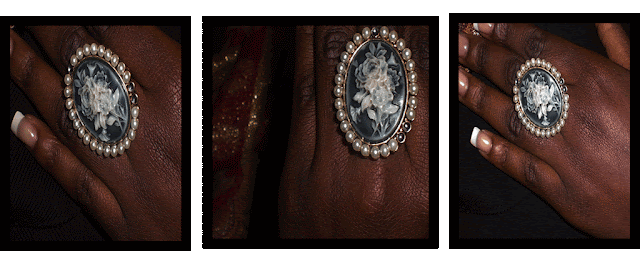
Modelled by Natalie Larbi is a perfect example of what I call VINTAGE!
This ring from purchased from DOROTHY PERKINS consists of some elements that Vintage accessories normally have.  The pearls, which have been around for Centuries are used as a very big part of adornment for the ring which I believe gives out the impression of Old Fashioned. The Floral Design on the ring based on a very aged background; just shouts at me ancient. Overall I really like the design of the ring, I think it is very Unique and wouldn’t really need to be worn with any other hand accessories because it would capture enough attention withstanding by itself,


This Pendant purchased from PRIMARK; also a very nice accessory which happens to have a vintage undertone to it. The colour of the Gold, the simplicity of the chain used and the singular locket as a pendant which was very common with Vintage necklaces, they normally had one item as the focus. This all came to mind when I saw this pretty locket.

Photography Avenue


This is one of the pictures that I took outside my college as a tester for my digital camera as I haven’t raised enough money to get my Nikon Professional. I simply gave it a bit of a touch-up on Photoshop mostly using the ‘Burn Tool’ and then using the ‘Dodge Tool’ to highlight the lighter parts of the image. I also changed the Level of the picture resulting in making it a bit darker and tweaked about with the ‘Brightness and Contrast’.

This is another picture I took while I was on the train; the Sunset was so beautiful so I thought why not Capture it?  For a little digital camera, I thought it takes quite good pictures!
I played about with the picture using ‘Brightness and Contrast’ and the ‘Burn Tool’. This picture didn’t need much modifying as the effect of the Sun was strong enough for me.
J


This is a picture I captured when I got on the platform. I thought it was pretty cool and the effect was quite nice.

This is my favourite of the bunch I think. J
I like the effect of the Sun setting in the background, the leaves slightly disguising it.
I like that you can only see a bit of the train tracks as there is a lot of shadows on the image. I think this image was a lucky capture but nevertheless I am very impressed with it.
J

Followers